Philosophy of Science
Learning Objectives
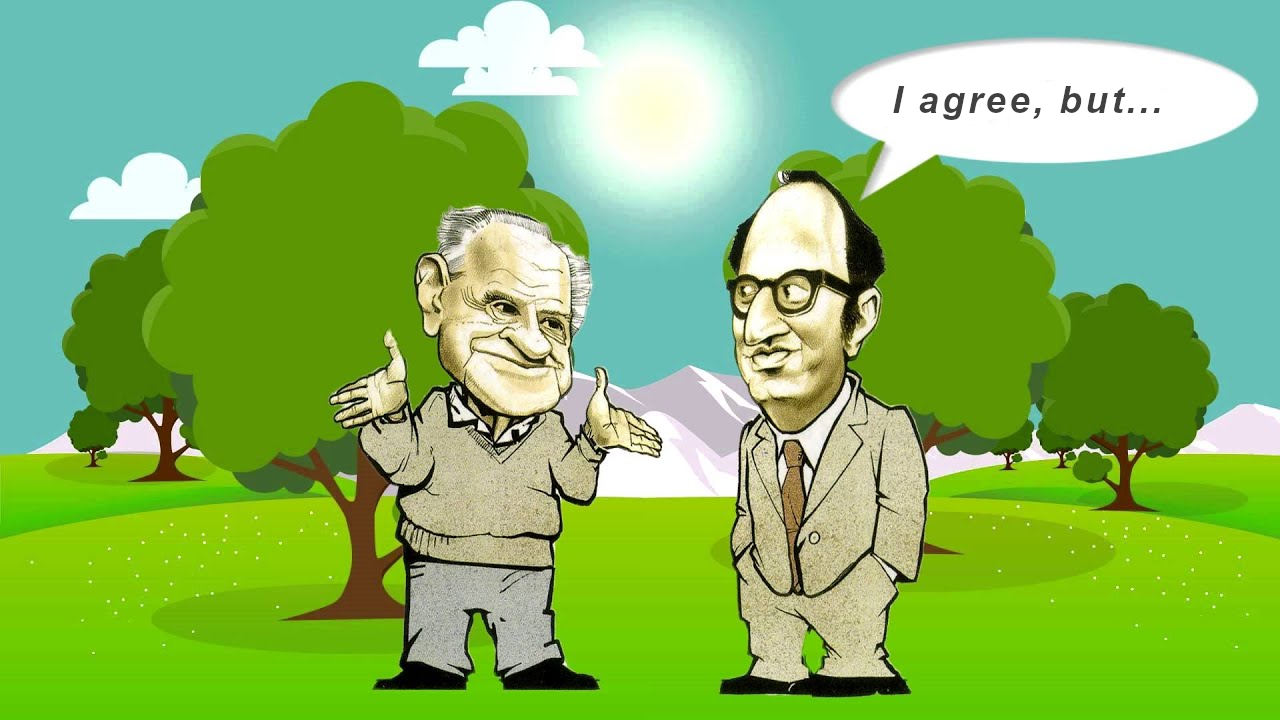
We will closely examine the perspectives of various thinkers on the question of what distinguishes science from non-science or pseudoscience, known as the demarcation problem. This will include a look on the historical ideas of philosophy of science (empiricism & positivism), and a detailed exploration of modern philosophers of science such as Karl Popper and Thomas Kuhn (refer to the picture above).
- Bem & Looren de Jong (2013), Chapter 3: Phil. of Science (1): Logical Positivism and its Failure
- Piekkola (2017), Chapter 7.1 & 7.2: Philosophy of Science \(^\textbf{*}\)
\(^\textbf{*}\) Only the two short subchapters on empiricism and positivism are relevant for us. You can use the ebook from the library or these scans of the printed book.
Tutorial Meeting
| Duration | Activity |
|---|---|
| 15 min. | Practice quiz on Canvas |
| 80 min. | In-depth questions & discussion in sub-groups |
| 15 min. | Break |
| 10 min. | Answers practice quiz |
| 30 min. | Plenary post-discussions and reflections |
| 15 min. | Closing: One-minute paper |
Question 1
Define the terms verifiability and falsifiability?
Question 2
Not every statements is verifiable and or refutable/falsifiable. Please indicate which statements are falsifiable and verifiable and, importantly, why do you think so?
| Statement | verifiable | falsifiable | |
|---|---|---|---|
| 1 | Ghosts exist. | \(\bigcirc\) | \(\bigcirc\) |
| 2 | Military officers are more socially embedded in the army than soldiers. | \(\bigcirc\) | \(\bigcirc\) |
| 3 | The immediate family is a social group. | \(\bigcirc\) | \(\bigcirc\) |
| 4 | The birth rate in the Netherlands will first drop, and then increase again. | \(\bigcirc\) | \(\bigcirc\) |
| 5 | Scorpios are often unable to work with their colleagues, and even have a tendency to be rude (astrology). | \(\bigcirc\) | \(\bigcirc\) |
| 6 | The id is the most primitive part of our psyche, being led by the principle of lust (Freud). | \(\bigcirc\) | \(\bigcirc\) |
| 7 | Our current fear of spiders is an adaptation that had an evolutionary advantage for our ancestors to survive (evolutionary psychology). | \(\bigcirc\) | \(\bigcirc\) |
Question 3
Following logical positivism, how can you prove the correctness of a statement/theory?
Question 4
What is the positivists’ standard view of science?
Question 5
One of the most fundamental critique against the logical positivism is that there are no theory-neutral observations. Explain what that means and give an example.
Question 6
Beside that problem of theory-neutral observations, Popper had a very principle critique critique of positivism? Explain this critique.
Question 7
Look at these two statements of Karl Popper.
- “A theory that explains everything is explains nothing.”
- “The more a theory forbids, the more it says about the world.””
To which concepts in his philosophy that that refer to?
Question 8
Explain the stages in Thomas Kuhn’s Phase model of science.
Question 9
Explain the term incommensurable and how does it play a role in the philosophy of Thomas Kuhn?
Discussion 1
To what extent do you think are Kuhn’s concepts of ‘paradigms’ and ‘incommensurability’ relevant for psychology? How might this affect communication and progress between different psychological sub-disciplines or schools of thought (e.g., behaviourism vs. cognitivism, or CBT vs. psychodynamic approaches)?
Discussion 2
Imagine two psychologists: one is strongly driven by Popper’s idea of falsification, the other beliefs in the importance of paradigms as described Kuhn.
What you think: how might their approaches to designing a new research project into a complex phenomenon like ‘burnout’ or ‘creativity’ differ? What would be the strengths and weaknesses of each approach in practice to your opinion?
Study Checklist
- Pioneers in the Philosophy of Science (from Piekkola subchapters)
- Empiricists: Lock & Hume
- Positivism: Comte & Mach, Vienna Circle
- Demarcation Problem
- Logical Positivism
- The Standard View
- Assumptions of Positivism (see lecture 3)
- Problems of Positivism
- especially (not independent) Observations
- Karl Popper
- Critique of Positivism
- Falsificationism
- critical vs. dogmatic Thinking
- Thomas Kuhn
- paradigms
- incommensurability
- Scientific revolution
- Phase model of scientific development (see lecture 3)
- Lakatos
- Competition between research programmes
- Empirical content